The short answer: The Business Model Canvas is a good planning tool: it describes how a business creates, delivers and captures value, on one page. The Traction Canvas is an execution tool: the sales playbook that shows you, step by step, how to go out and win customers once you know the model. Plan with the Business Model Canvas, execute with the Traction Canvas. We recommend the Business Model Canvas for an existing company launching a new product.
Where they overlap and where they differ
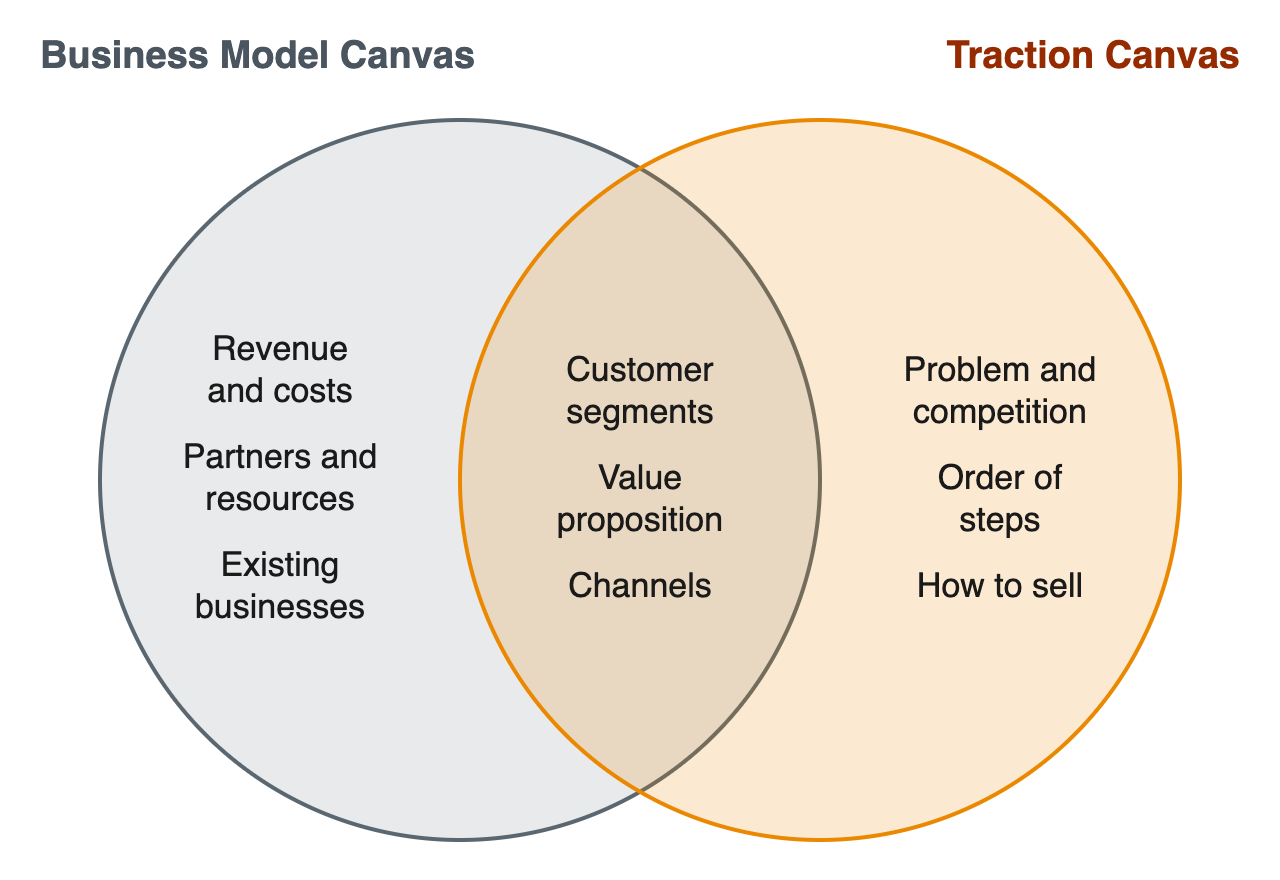 Left: covered by Business Model Canvas only. Middle: covered by both. Right: covered by the Traction Canvas only.
Box by box
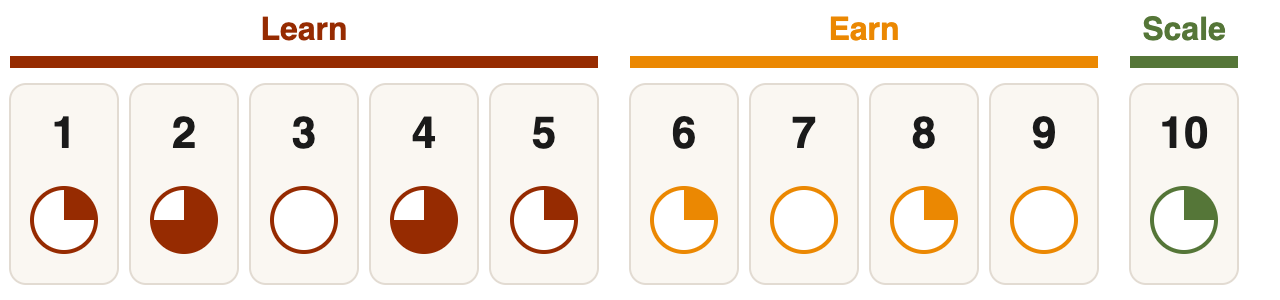 How much the Business Model Canvas covers each Traction Canvas box. Full circle: a core focus. Empty: not covered. This is our own assessment, see all models compared.
What the Business Model Canvas does well
Alexander Osterwalder created the Business Model Canvas with Yves Pigneur, and their 2010 book Business Model Generation made it a standard. Its nine blocks cover customer segments, value propositions, channels, customer relationships, revenue streams, key resources, key activities, key partnerships and cost structure. Later work from Strategyzer, including Testing Business Ideas by David Bland and Alexander Osterwalder, added ways to test the assumptions behind each block. • It gives the whole team a shared, one-page view of the business.• It works well for established companies exploring a new product or market.
• It covers revenue, costs, partners and resources, the parts of a business the Traction Canvas does not.
How the Business Model Canvas maps to the Traction Canvas
The Traction Canvas has ten boxes in three zones, completed in order: Learn (Boxes 1 to 5), Earn (Boxes 6 to 9) and Scale (Box 10). Here is how the Business Model Canvas lines up with it.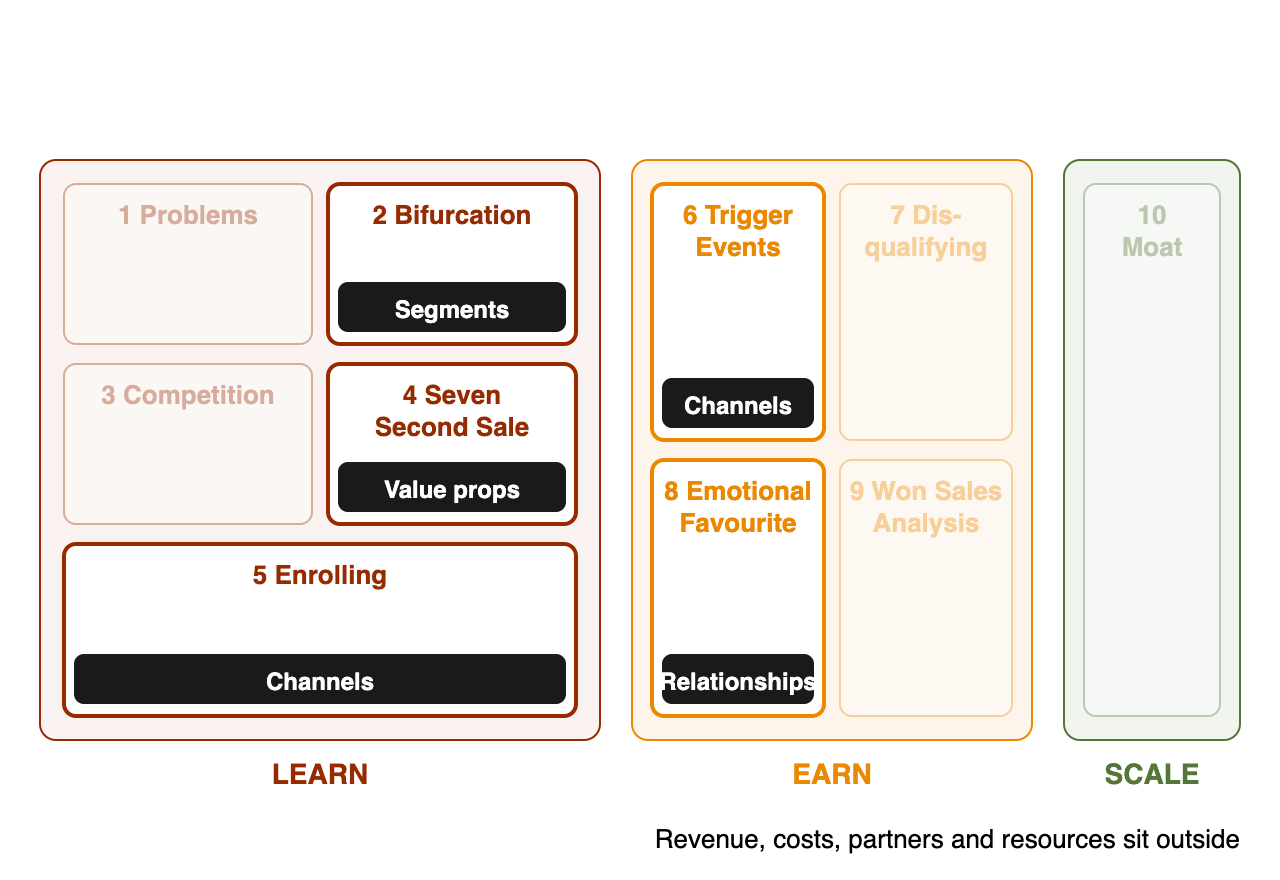 Where the Business Model Canvas lands on the Traction Canvas. Faded boxes are not covered. The table below has the details.
Customer segments → Box 2: Bifurcation (Learn zone). Bifurcation narrows the segment to the buyers most likely to act now.
Value propositions → Box 4: Seven Second Sale (Learn zone). The Seven Second Sale turns the value proposition into almost instant interest.
Channels → Box 5: Enrolling and Box 6: Trigger Events (Learn, Earn zone). Enrolling and Trigger Events are the first sales channels for a new product.
Customer relationships → Box 8: Emotional Favourite (Earn zone). Emotional Favourite makes you the vendor buyers prefer and trust.
Revenue streams and cost structure → Outside the canvas. Outside the Traction Canvas. The Business Model Canvas covers these, the Traction Canvas does not.
Key resources, activities and partnerships → Outside the canvas. Outside the Traction Canvas. These are the operating side of the business.
The gap the Business Model Canvas leaves
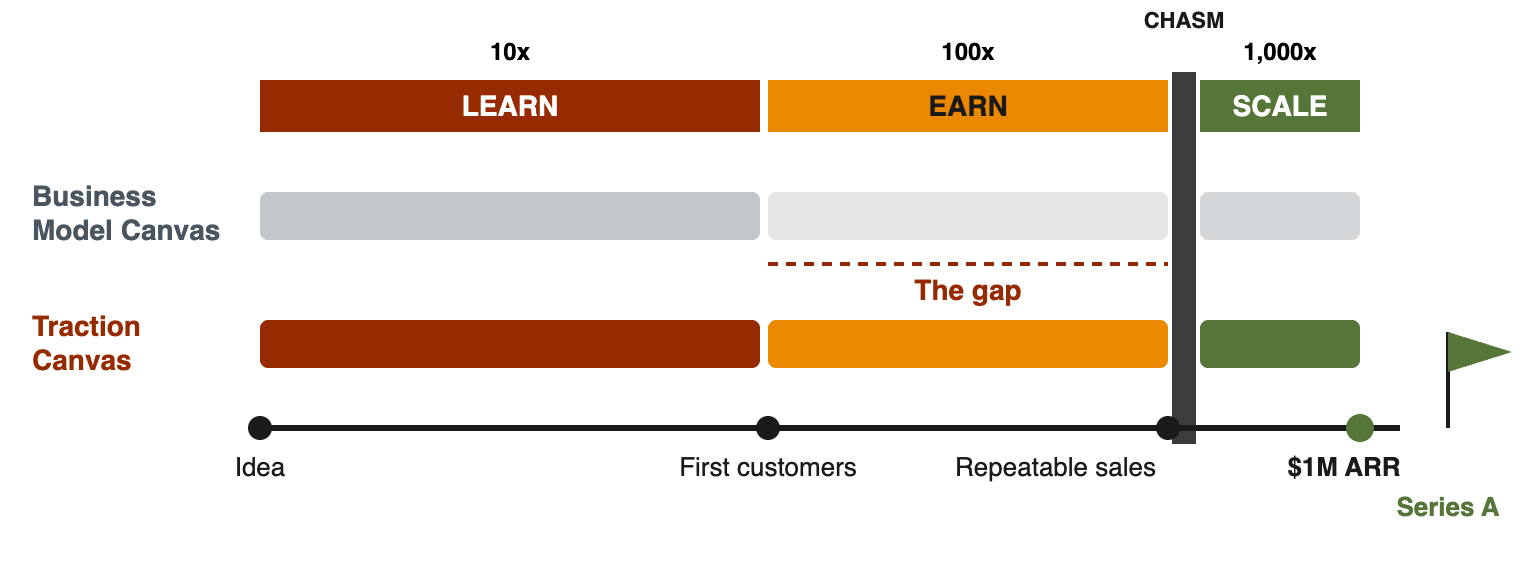 How far each canvas takes a founder on the road to $1M in ARR and a Series A. Bar strength shows how much of each zone is covered, using the box-by-box ratings above.
The Business Model Canvas shows what the business is, but not what to do first or how to win the first customers. It has no block for the problem or the competition, and nothing on timing, qualifying buyers or repeatable wins, which are the Earn boxes (6 to 9).