“Three questions that find the 12.5% of the market most likely to become your customer.”
Master this box and you stop pitching everyone — and start converting the 12.5% most ready to buy now.
Which box is holding you back from reaching $1,000,000?
START HERE
You’re pitching everyone — BUT converting no one.
Asked who your customer is, you say “anyone who has the problem.” Focus feels risky, so you pick the bigger half because “there’s more opportunity there” — but the bigger half is more obvious, more crowded, and more comfortable, which is exactly why it’s harder to win.
→ Be honest: are you going wide because it’s right, or because it’s comfortable?
DO THE WORK
Ask the Three OR Questions.
Three either/or cuts halve the market again and again — from “everyone” down to the few most motivated to buy now, your Initial Client Profile.
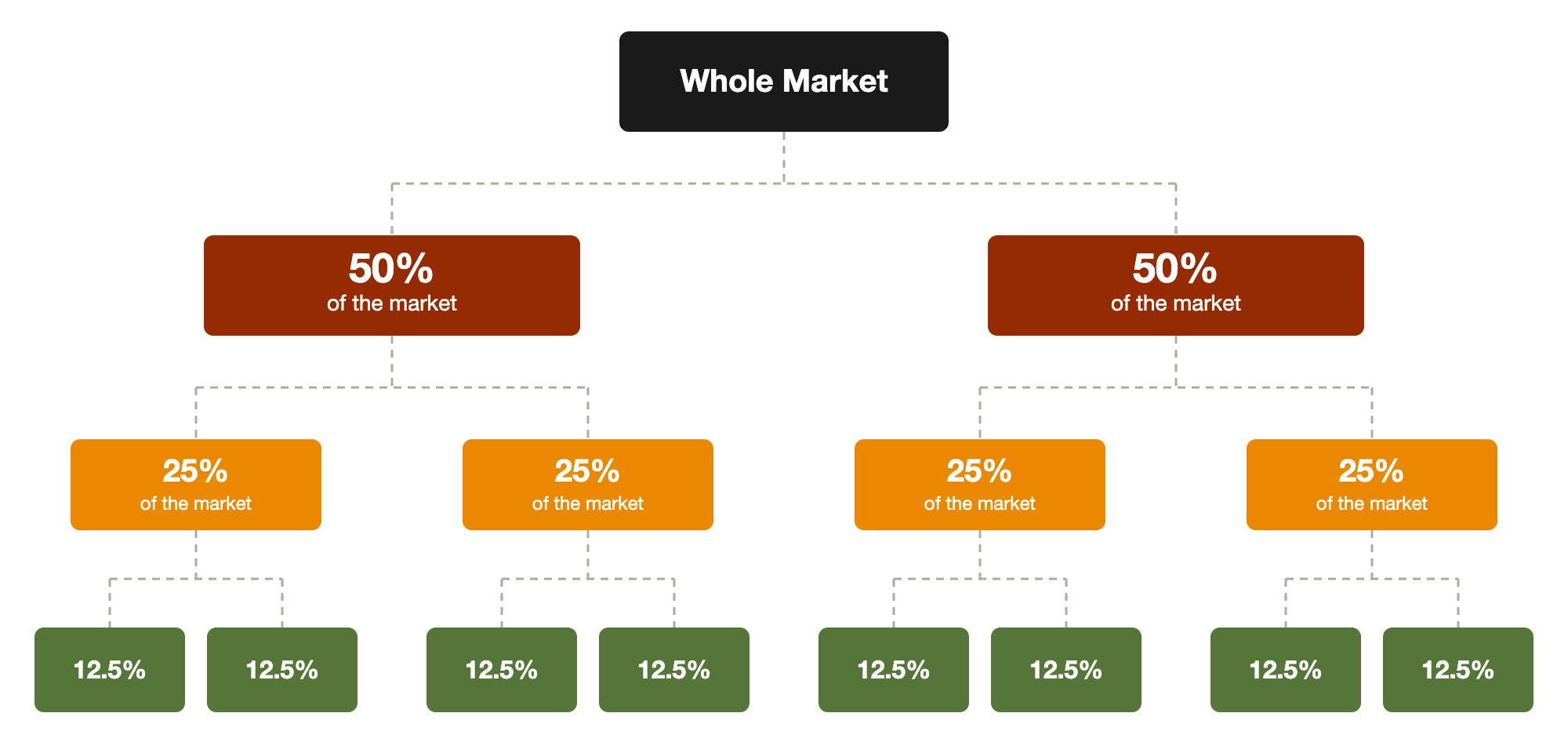 Split the market in half three times and you land on the 12.5% most likely to buy — your ICP.
You grow 2X faster going narrow, not wide. In retail the secret is location, location, location. For a startup it’s focus, focus, focus — one problem, one customer type, one industry or geography.
“Profile, not Persona. Client, not Company.”
Split the market in half three times and you land on the 12.5% most likely to buy — your ICP.
YOU’RE READY
You can name one specific person — not a company, not a persona.
When your ICP is a single, reachable Initial Client Profile, you’ve mastered Bifurcation. Move on to Competition.
IN THE RESTAURANT EXAMPLE
Restaurant scheduling software, cut three times.
(1) Independents, or chains? → independents. (2) Already using a scheduling tool, or none at all? → none at all, more pain, more motivated. (3) Owner-operators, or restaurants with a dedicated manager? → owner-operators, who feel the scheduling pain personally every week. Three cuts, 12.5% of the original market, one specific person: an independent restaurant owner-operator with no scheduling tool today.
THE THREE BIGGEST MISTAKES
SKIP
You target several markets at once and never actually bifurcate.
SHORTCUT
You make the cut but pick the bigger half because it “feels like more opportunity” — the crowded side that’s hardest to win.
STUMBLE
You pitch the early majority before they’re ready to buy — they want proof and references you don’t have yet, instead of innovators and early adopters who’ll buy on vision alone.