3 Questions to Ask About Box 6 — Trigger Events
1. You have named 3 specific trigger events — a Bad Experience or Change that recently created new dissatisfaction — not something they have become numbed to and just put up with
What does "The ABC Model — Trigger Events" mean?
A three-category system for naming the events that shift a prospect from comfortable to actively looking — but only two of the three reliably do it.
<u>A</u> = Awareness (Economics, Risk, Legal) — they learn something, but nothing in their world has actually changed yet. Rarely enough on its own.
<u>B</u> = Bad Experience (with People, Product, or Provider) — something happened.
<u>C</u> = Change (in People, Places, or Priorities) — something happened.
Your 3 named triggers should come from B or C. People don't change until something changes — and Awareness alone isn't a change.
Reaching a prospect after the first event that makes them unhappy with the status quo but before they define the problem and design the solution makes you roughly 500% more likely to close than if you wait until the second event that gives them the time, money, or resources to buy the solution.
Without a trigger, you are interrupting someone with no reason to act — which is why untargeted cold outreach converts so poorly. The trigger is the difference between an interruption and an answer.
Awareness is the exception — learning a fact about risk or economics doesn't disrupt the status quo the way an actual Bad Experience or Change does, so it rarely produces the same urgency.
1. List your last 5 closed deals.
2. For each, ask what changed in that customer's world in the 30–90 days before they started looking.
3. Sort each into A, B, or C — but weight B and C higher; A rarely creates real urgency on its own.
4. Count which category appears most — that is the trigger to build your detection system around.
5. Write your 3 triggers as named events, not feelings. "Hired a new operations manager" is a trigger. "Frustrated with scheduling" is something they have become numbed to and just put up with, and that kind of ongoing condition never creates urgency.
Example: For a restaurant scheduling tool, all three top triggers were Category C: new manager hired, new location opened, ownership changed. Each one puts a person in a seat who wants to prove themselves by fixing what's broken — and has a short window of political capital to spend on new tools.
2. You have implemented a system — such as LinkedIn, job postings, or press releases — that you check at least weekly to catch trigger events
What does "Trigger Event Detection System" mean?
The monitoring setup that tells you when a specific trigger event fires for a specific prospect — turning your trigger list from knowledge into timing.
Detecting a trigger within 48 hours makes you roughly 500% more likely to close than finding out a month later, because by then the prospect has usually chosen someone.
Knowing which triggers matter without a way to detect them means you find out about the window after it has closed.
1. Set Google Alerts combining your target industry with trigger keywords — "new operations manager," "opens second location."
2. Follow target companies on LinkedIn and turn on notifications for job changes.
3. Subscribe to the trade publications and job boards where your ICP's hiring gets announced.
4. Log every detection: company, trigger type, date detected, date contacted. Your goal is under 48 hours between the two.
5. Review the log monthly — if your detection-to-contact gap is growing, the system needs pruning, not more sources.
Example: A founder set a LinkedIn alert for the job title "Restaurant Manager" within a 50km radius. A new manager posted about starting her role on a Tuesday. He sent a short, useful note on the Wednesday. She replied within an hour — she had spent her first two days discovering the scheduling mess she had inherited.
3. In your last five outreach attempts, you reached out on the trigger event that creates dissatisfaction — not the second event, once they have the time, money, or resources to start searching for alternatives
What does "The Window of Dissatisfaction™" mean?
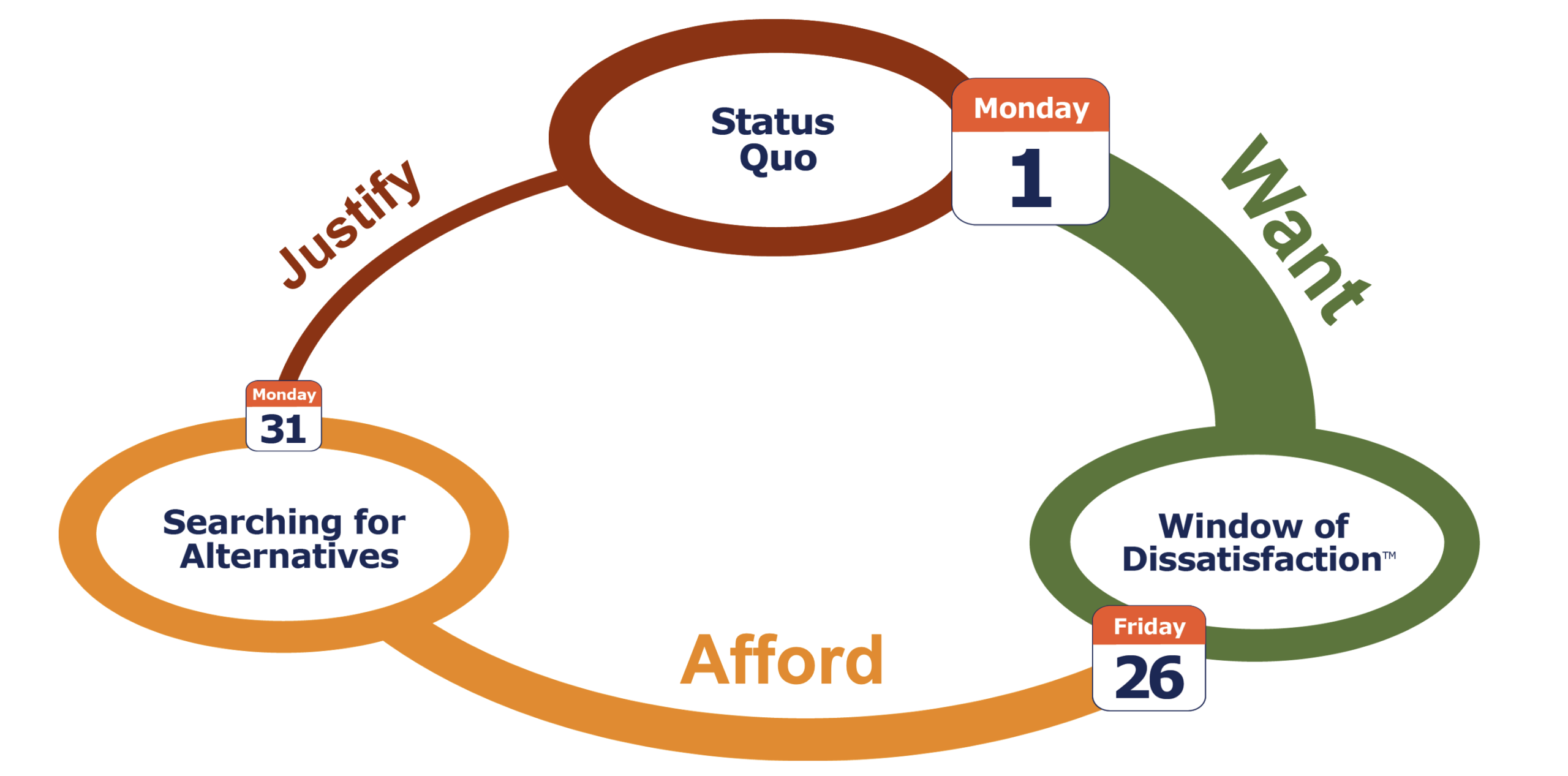
The gap between two of the three trigger events behind every sale: the <b>Want Trigger</b>, when a prospect first becomes dissatisfied with their status quo, and the <b>Afford Trigger</b>, when something gives them the time, money, or resources to actually start searching for alternatives. The window is open between the two — reach out on the Want Trigger and you get there before anyone else is even looking; wait for the Afford Trigger and you're now one of several options they're actively comparing.
There's a third trigger — the Justify Trigger, the one that finally lets a prospect say yes — see the Trigger Event Backwards Map for the full three-trigger picture.
Reaching out on the Want Trigger means you get to help shape the solution before there is budget or urgency pulling in every direction, so you are already the natural choice by the time the Afford Trigger happens and they start actively searching.
Wait for the Afford Trigger and you are competing with everyone else who spotted the same signal, at the exact moment the prospect has the most options in front of them.
1. Detect the Want Trigger (see the ABC Model above) — the event that creates real dissatisfaction, not a chronic complaint.
2. Reach out on it immediately, before the Afford Trigger ever happens — do not wait for a budget approval, a new hire, or any other signal that "now it's real."
3. If you missed the Want Trigger, watch for the Afford Trigger instead — it is a weaker position (you are now visible alongside competitors), but still better than cold outreach.
4. Track how many of your outreach attempts happened on the Want Trigger versus the Afford Trigger, and compare close rates between the two groups.
Example: A new operations manager posted about starting her role on a Tuesday — her Want Trigger. One founder reached out that same week, before her Q1 budget was even approved (her Afford Trigger), and helped her build the case for it herself.
A competitor waited until the budget was approved and reached out then — by that point, she had already decided who she was buying from.