your position on the canvas · red → green
“
Find a problem big enough that people want to become your customers now, NOT later.
”
Master this box and the right buyer stops saying “neat idea” and starts saying “that’s exactly me — when can I buy?”
Work top to bottom:Start→Do the work→You’re ready
START HERE
You’ve built a vitamin, not a painkiller.
People say “interesting,” “neat,” “cool idea” — never “that’s exactly me, when can I buy?” That’s not a pitch problem. It’s a problem problem, and “later” usually turns into never.
→ Be honest: are you selling a painkiller, or a vitamin?
DO THE WORK
Play Problem Bingo™.
Score your problem against the six characteristics of a problem worth solving:
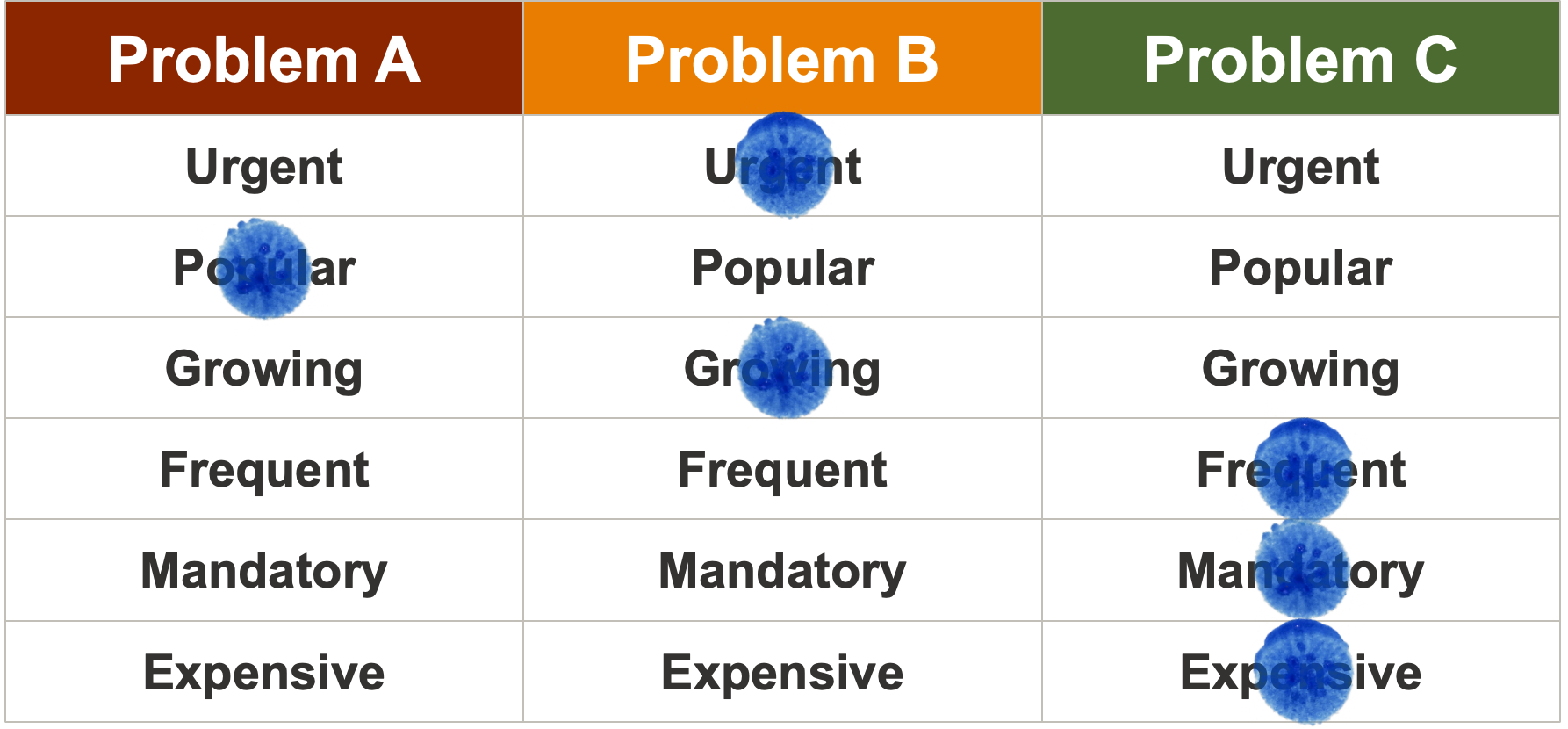
Problem Bingo scoring example: Problems A, B, and C scored against Urgent, Popular, Growing, Frequent, Mandatory, Expensive
1–2 = vitamin3 or more = painkiller
Then prove it in one sentence so specific the right buyer says “that’s me” — the Seven-Part Problem Statement names who has the problem, what it costs them, and why everything they’ve tried falls short.
“Buyers won’t spend $50 to solve a $100 problem. They WILL spend $50 to solve a $500 problem.”
YOU’RE READY
You can state the problem in one sentence — with a dollar cost attached.
When the right buyer hears it and says “that’s me,” you’ve mastered Box 1. Move on to Bifurcation.
THE THREE BIGGEST MISTAKES
SKIP
Guess the problem instead of testing candidates — you build on a foundation that isn’t there.
SHORTCUT
Name a problem but never attach a dollar cost — false urgency instead of proven pain.
STUMBLE
You describe the problem in your own words instead of the words your customer actually uses — so it never lands as “that’s exactly me.”

3 Questions to Ask About Box 1 — Problems

1. You analyzed at least 3 problems you think you solve to find the one that causes the greatest pain so you can position your solution as a painkiller (something they'll pay to fix it now) rather than a vitamin (something they'll put off, maybe forever). We teach a simple process called Problem Bingo that uses six problem characteristics to uncover which problem causes the greatest pain.

What does "Problem Bingo" mean?
Problem Bingo
“3 or more = painkiller. 2 or fewer = vitamin.”
What

A scorecard built on six problem characteristics — Urgent, Popular, Growing, Frequent, Mandatory, Expensive — that tells you whether the problem you picked is worth solving, before you spend a year building for it.

Why

Buyers give roughly 10x more business to founders solving painkillers than vitamins. A vitamin gets you enthusiastic demos and silent inboxes.

Problem Bingo costs you fifteen minutes and can save you eighteen months building something nobody urgently needs.

How

1. Write your problem at the top of a page.

2. Score 1 point for each honest yes: Urgent (needs solving now) · Popular (affects many in your ICP) · Growing (getting worse) · Frequent (recurs regularly) · Mandatory (can't be ignored) · Expensive (costs real money).

3. Total the score. 3+ = painkiller, proceed. 2 or below = vitamin, stop.

4. If you score 2 or below, go back to your list of 3 problems and run Bingo on the next one. Don't rationalise a low score — that's the trap.

Example: Restaurant scheduling conflicts: Urgent ✓ (happens this week) · Popular ✓ (every manager) · Growing ✓ (staff turnover rising) · Frequent ✓ (weekly) · Mandatory ✗ (they can limp along) · Expensive ✓ ($800/month). Score: 5/6 — clear painkiller.

Compare to "restaurants want better branding": Urgent ✗ · Popular ✓ · Growing ✗ · Frequent ✗ · Mandatory ✗ · Expensive ✗. Score: 1/6 — vitamin.

2. You have calculated the full quantifiable cost of the problem in time, money, and resources

What does "Quantifiable Implications" mean?
Quantifiable Implications
“The total cost of the problem compared to the price of your solution is how they justify their purchase to themselves, their superiors, and their subordinates.”
What

The total measurable cost of the problem to your initial client profile: money lost, time wasted, and resources consumed, added together into one number.

Why

Your potential customer (aka prospect) often focuses only on the initial direct cost of their problem, not its implications or consequences.

This reduces the ROI of your solution which makes it less likely someone can justify the purchase to themselves or others.

ROI = ((problem cost + implication cost − solution cost) ÷ solution cost) × 100

The implications of a problem are often 2x, 5x, or even 10X the initial problem cost the prospect initially tells you about.

The pain of staying must be greater than the cost of switching.

Without adding the implication costs, the ROI is often too small for someone to overcome the switching costs (purchase, delivery, use, supplements, maintenance, disposal) of becoming your customer.

How

1. Ask the customer: "What does this problem cost you directly, per year?" Do not answer for them.

2. Then ask: "What else does this problem cause or make worse?" — the implications. Add up money, time, and resources for the direct cost, then do the same for the implications, both as annual totals.

3. Add direct cost + implication cost together, then divide by your annual price. That's your real multiplier.

Example: A restaurant owner said scheduling conflicts cost $800 a month in overtime — $9,600 a year in direct cost. That's the number he led with.

But that wasn't the whole story: two experienced servers quit that year because of the chaotic scheduling, costing $3,000 each to replace — $6,000 in implication cost he never mentioned until asked directly.

At $99/month, solution cost is $1,188/year.

ROI without implications: ((9,600 − 1,188) ÷ 1,188) × 100 = 708%

ROI with implications: ((9,600 + 6,000 − 1,188) ÷ 1,188) × 100 = 1,213%

Leaving out the implication cost understated the real ROI by nearly half — the difference between a sale that's hard to justify and one that isn't.

3. You can describe the emotional impact of the problem using the exact words your initial client profile uses to describe how it makes them feel

What does "Emotional Impact" mean?
Emotional Impact
“People buy on emotion and justify with logic. Know the emotion first.”
What

One of the seven components of a complete problem statement: the specific way the problem makes your ICP feel, captured in their words rather than yours.

Why

The emotional impact is what moves a prospect from "interested" to "urgent," because the decision to change is made emotionally and defended logically afterwards.

Naming their feeling before they have told you creates a level of being understood that most vendors never reach — and understanding is what earns the meeting.

How

1. In every interview and Won Sales Analysis call, ask: "How does this problem make you feel?" or "What's the most frustrating part of dealing with this?"

2. Write down their exact words. Do not tidy them up.

3. After 5 interviews, find the feeling that repeats — frustrated, overwhelmed, embarrassed, anxious, exhausted, stuck.

4. Put that exact phrase into your problem statement and your Seven Second Sale.

5. If people give you a thinking answer instead of a feeling answer, ask again with "and how does that feel when it happens?"

Example: Asked how scheduling conflicts made them feel, three separate managers used almost the same words: "like I'm constantly putting out fires — nothing's ever under control." That phrase went into the Seven Second Sale verbatim. Prospects started finishing the sentence before the founder did.