your position on the canvas · red → green
“
How to differentiate yourself from the three forms of competition every startup has.
”
Master this box and investors see a big market — and you win on the cost of the problem, not a feature war.
Work top to bottom:Start→Do the work→You’re ready
START HERE
“We don’t really have any competition.”
You say it proudly to an investor — and the room goes cold. “No competition” tells investors your market is small. In truth you always have competition — and naming it the right way is how you win.
→ Name what your buyer is already paying to solve this problem.
DO THE WORK
Ask “What” is my competition, not “Who.”
Every startup faces three forms of competition — the alternatives your buyer is already paying for. Name all three, then compete on the cost of the problem:
DIRECT
The nearest rival selling the same thing you do.
Strategy: Avoid.
MOST COMMONLY USED
The everyday alternative most people default to — often a spreadsheet or manual workaround.
Strategy: Be different, not better.
MOST EXPENSIVE
The premium, highest-priced option in the category.
Strategy: Be cheaper.
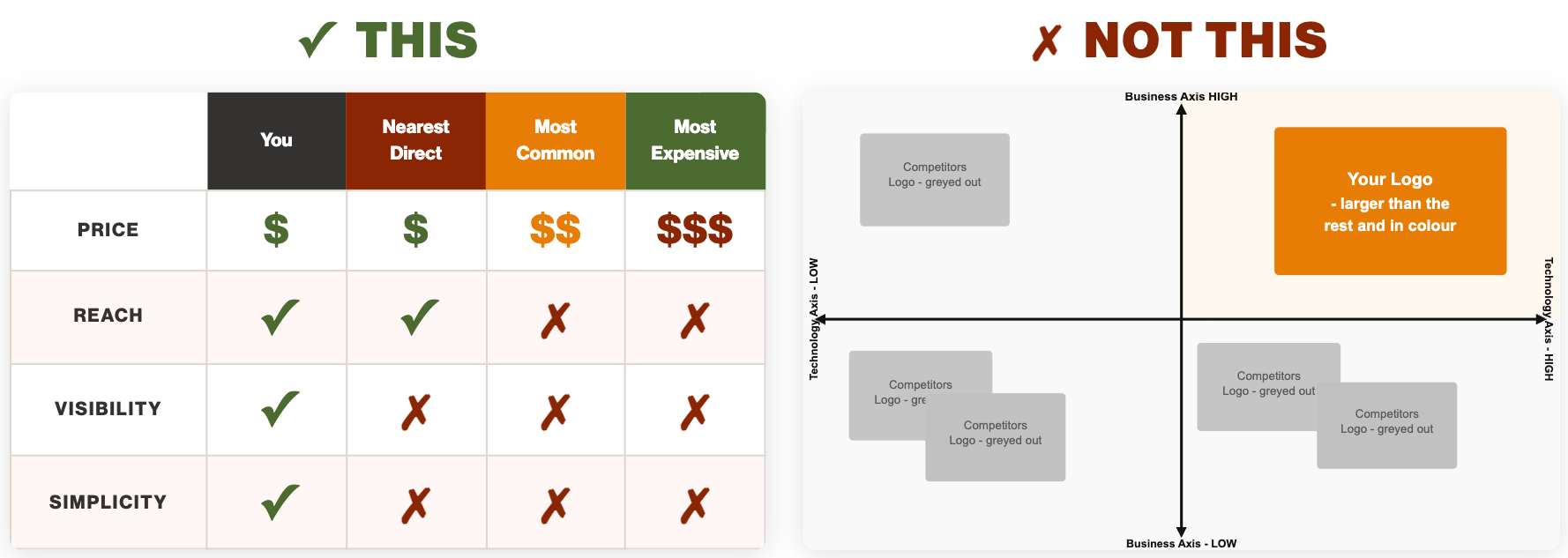
You vs the alternatives: price, reach, visibility, and simplicity compared to the nearest direct, most common, and most expensive competitors
The test: if your solution costs less than the problem does, you win.
Doing nothing is NOT your competition. If a prospect isn’t already spending time, money, effort, energy or resources on this problem, there’s nothing to displace. Until a trigger event makes it urgent, move on — and spend your time with buyers who are already paying to solve the problem you solve.
The #1 thing investors care about is market size. Southwest didn’t compete with airlines — they competed with trains, cars and buses, reframing the category. Julie Angus won two $100K pitch competitions in two days by comparing her ocean drone not to other drones but to the $18,000/day research ships solving the same problem.
“Ask ‘What’ is my competition — not ‘Who’ are my competitors.”
YOU’RE READY
You can name what the problem costs — and show your solution costs less.
When you compete on the cost of the problem instead of a feature checklist, you’ve mastered Competition. Move on to the Seven Second Sale.
THE THREE BIGGEST MISTAKES
SKIP
You compete on features against rivals — the “who” — instead of pricing against the cost of the problem — the “what” — and end up in a race to the bottom.
SHORTCUT
You claim you “have no competition,” which blinds you to the alternatives your buyer is already paying for.
STUMBLE
You name the three forms but never build the comparison grid — so you can't actually show a prospect why you cost less across all three.

3 Questions to Ask About Box 3 — Competition

1. In your last five prospect conversations, you talked about how you're different from the alternatives, not better than a direct competitor

What does "Displacement Not Head-to-Head" mean?
Displacement Not Head-to-Head
“The easiest competitor to beat is the one your customer forgets to compare you to.”
What

A positioning discipline: focus on "what" the competition is — the Most Commonly Used alternative, where you win by being different, and the Most Expensive alternative, where you win by being cheaper — not "who" the competition is.

You are not trying to take business away from direct competitors; the status quo is the real fight.

Why

Your prospect is rarely choosing between you and another startup — they are choosing between you and continuing as they are. The status quo carries zero switching cost, zero learning curve, and zero perceived risk, which is exactly why it wins most deals.

You beat it by making the ongoing cost of staying visible, not by adding features.

How

1. Open every discovery call by asking what they do about this today.

2. Frame everything that follows against that answer, not against competitors they did not mention.

3. Quantify the cost of staying: "your current process costs three hours a week — that's $150 a month before the overtime."

4. Only discuss direct competitors if the prospect raises them first.

5. If you find yourself comparing feature lists, you have drifted into head-to-head. Return to the cost of the status quo.

Example: Calendly did not win by out-featuring other scheduling tools. It displaced "reply to this email with three times that work for you" — an alternative nobody had thought to call competition. That framing created the category and made the feature comparison irrelevant.

2. You have identified the three forms of competition: direct competitors, most commonly used, and most expensive

What does "The 3 Forms of Competition" mean?
The 3 Forms of Competition
“Your real competition is the status quo.”
What

Every prospect is already handling their problem somehow.

Three forms exist: Direct competitors (built for the same problem), Most Commonly Used (what they actually do today — usually a spreadsheet or absorbing the cost), and Most Expensive (the highest-cost alternative available).

Why

Most founders position against direct competitors — who represent maybe 10% of lost deals. The other 90% are lost to "we'll keep doing what we're doing."

Naming all three forms lets you attack the alternative that's actually winning, and lets you price against the ceiling instead of the floor.

How

1. Name one specific direct competitor.

2. Ask 5 customers: "What do you do about this today?" Their answer is the Most Commonly Used form — write down their exact words.

3. Find the most expensive way this problem gets solved (usually enterprise software or hiring someone). That's your price ceiling.

4. Focus every sales conversation on displacing form 2 or 3 — never on out-featuring form 1.

Example: Southwest Airlines named their competition as cars, buses, and trains — not other airlines. That reframe changed their pricing, their routes, and their marketing.

For a restaurant scheduling tool: Direct = other scheduling apps. Most Commonly Used = Google Sheets plus group texts. Most Expensive = hiring a part-time scheduler at $2,000/month.

3. You have a 4 X 4 competition grid that compares your value against all three forms of competition

What does "The Competition Grid" mean?
The Competition Grid
“Four rows. Four columns — you plus all three forms of competition.”
What

A one-page, 4 X 4 comparison: four columns (your solution, the Direct competitor, the Most Commonly Used alternative, and the Most Expensive alternative) and four rows, each a specific, verifiable way you add value.

Why

"We're better" is unfalsifiable and prospects discount it automatically. Four verifiable differences checked against every real alternative — not just one — answers the only question that matters to them: "why would I change what I'm already doing?"

The grid also exposes gaps in your own understanding — if you cannot fill in a column, you need more customer conversations, not better copy.

How

1. Set up four columns: your solution, the Direct competitor, the Most Commonly Used alternative, and the Most Expensive alternative.

2. Fill four rows with differences a customer could verify themselves. "Easier to use" fails. "Zero IT setup versus a 3-week implementation" passes.

3. Check each row against all three competition columns — you may win a row against one form and not another, which tells you exactly where your position is strongest.

4. Test each cell by asking: could a sceptical prospect check this in five minutes? If not, rewrite it.

5. Bring the grid to sales conversations rather than a feature list.

Example: Restaurant scheduling software, 4 X 4: vs. Direct competitors — real-time visibility they don't offer. vs. Most Commonly Used (Google Sheets + group texts) — automatic conflict alerts instead of manual cross-checking. vs. Most Expensive (a $2,000/month part-time scheduler) — $149/month, works on a phone on the floor instead of a laptop in the office. Fourth row, true across all three: built specifically for under-20-staff restaurants, not generic scheduling.