compare
Where they overlap and where they differ
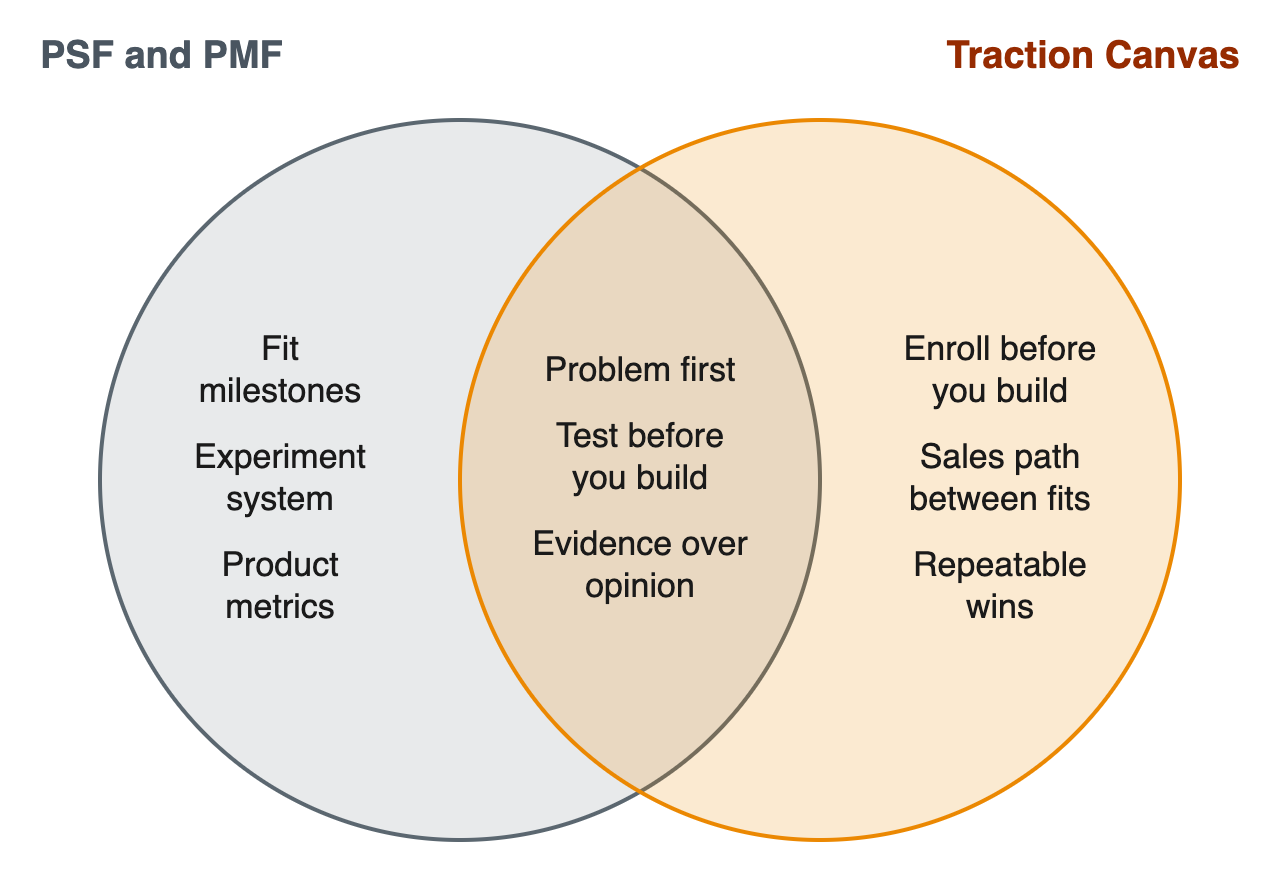 Left: covered by PSF and PMF only. Middle: covered by both. Right: covered by the Traction Canvas only.
Box by box
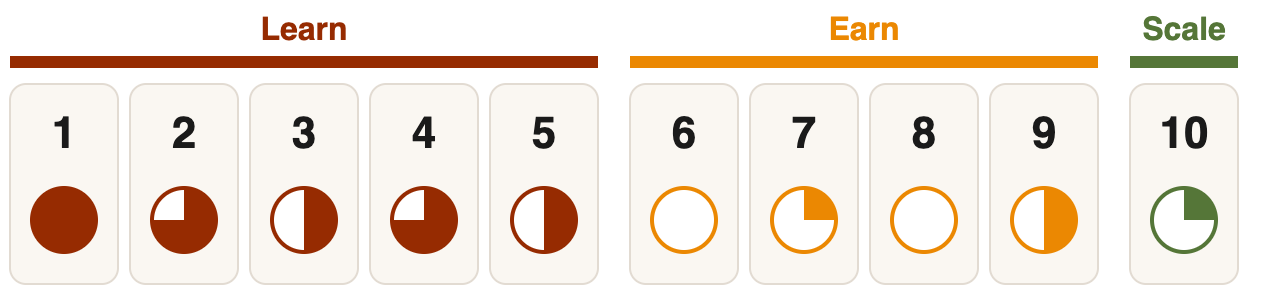 How much PSF and PMF covers each Traction Canvas box. Full circle: a core focus. Empty: not covered. This is our own assessment; see all models compared.
The short answer: Problem-solution fit and product-market fit are milestones: they tell you where you are. The Traction Canvas gives founders the steps to reach each one, in order, with selling built in from the start.
What PSF and PMF does well
In Running Lean, Ash Maurya describes three stages: problem-solution fit (you have a problem worth solving), product-market fit (you have built something people want), and scale. Each stage has its own experiments and a clear signal that it is time to move on. • It gives founders clear checkpoints instead of a vague idea of progress.• It puts problem interviews before building.
• Its experiments make learning measurable.
How PSF and PMF maps to the Traction Canvas
The Traction Canvas has ten boxes in three zones, completed in order: Learn (Boxes 1 to 5), Earn (Boxes 6 to 9) and Scale (Box 10). Here is how PSF and PMF lines up with it.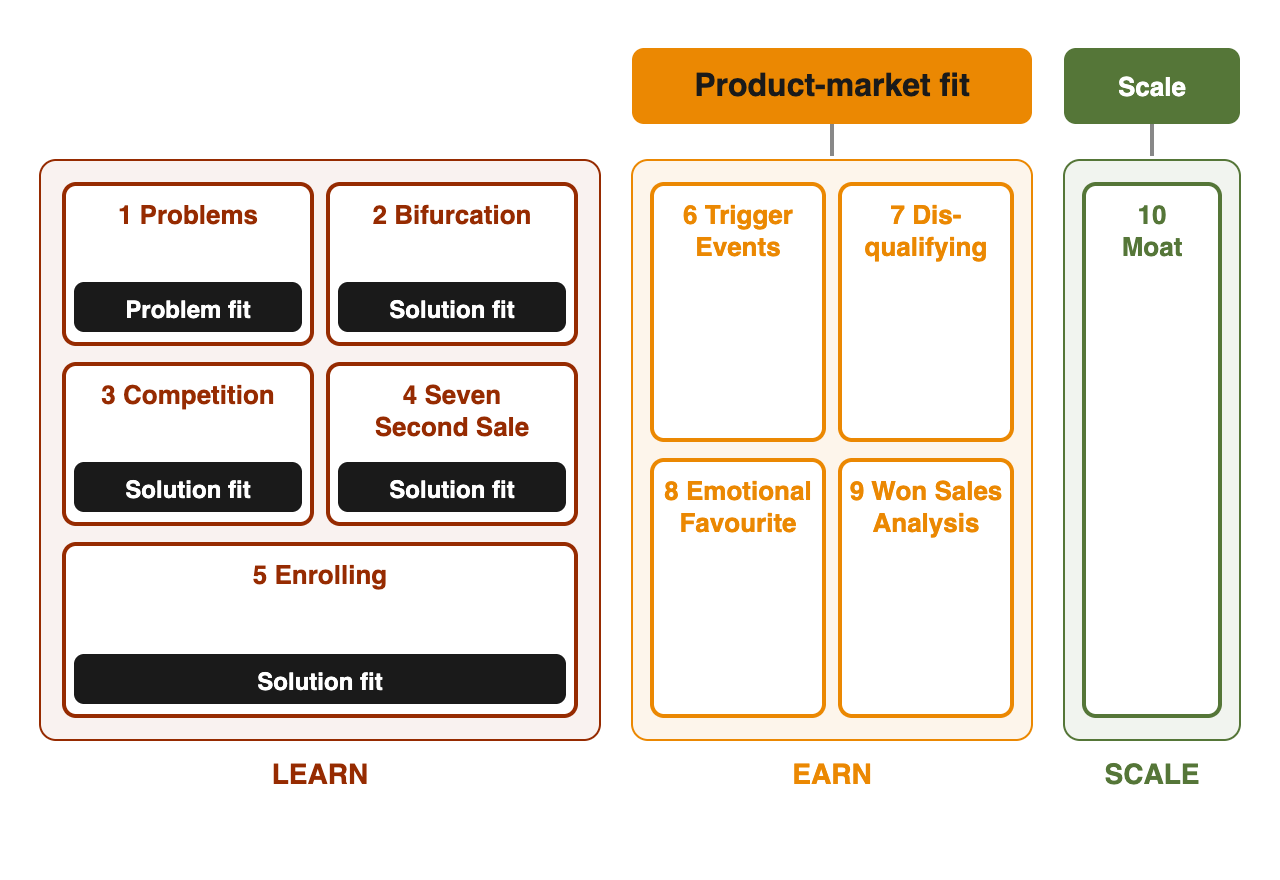 Where PSF and PMF lands on the Traction Canvas. Faded boxes are not covered. The table below has the details.
Problem fit — Traction Canvas: Box 1: Problems / Learn zone. How it connects: Problems finds a problem big enough that people want to buy now, not later.
Problem-solution fit — Traction Canvas: Box 2: Bifurcation / Box 3: Competition / Box 4: Seven Second Sale / Box 5: Enrolling / Learn zone. How it connects: Bifurcation, Competition, the Seven Second Sale and Enrolling test the solution with real buyers before you build.
Product-market fit — Traction Canvas: Box 6: Trigger Events / Box 7: Disqualifying / Box 8: Emotional Favourite / Box 9: Won Sales Analysis / Earn zone. How it connects: Repeatable, qualified wins are the evidence of product-market fit.
Scale — Traction Canvas: Box 10: Marketing Moat / Scale zone. How it connects: The Marketing Moat grows the business through word of mouth.
The gap PSF and PMF leaves
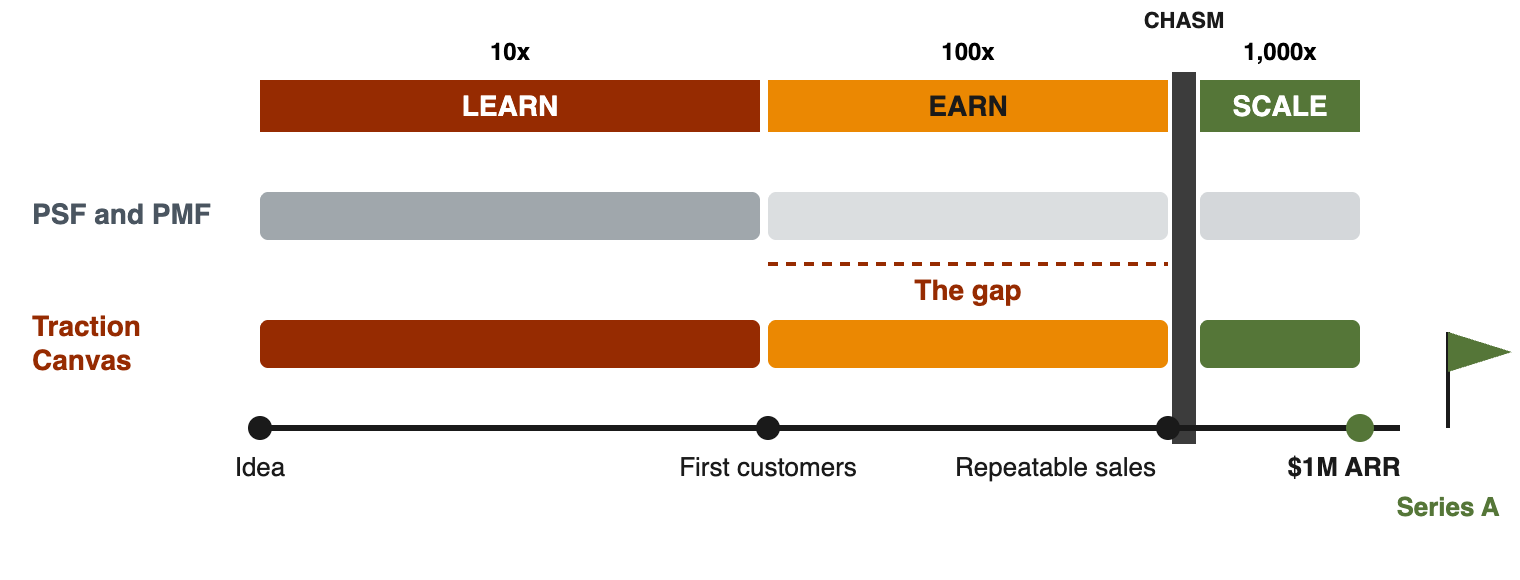 How far each canvas takes a founder on the road to $1M in ARR and a Series A. Bar strength shows how much of each zone is covered, using the box-by-box ratings above.
The fit milestones tell you when you have arrived but not how to sell in between. Getting meetings with strangers, qualifying opportunities and closing repeatably are the Earn boxes (6 to 9), which is where many founders with a good product stall.