“We marketed Feature X, but customers value Feature Y we barely mentioned.”
3 Questions to Ask About Box 9 — Won Sales Analysis
1. You have conducted a Won Sales Analysis interview within 72 hours of every closed deal
What does "Won Sales Analysis — Why 72 Hours" mean?
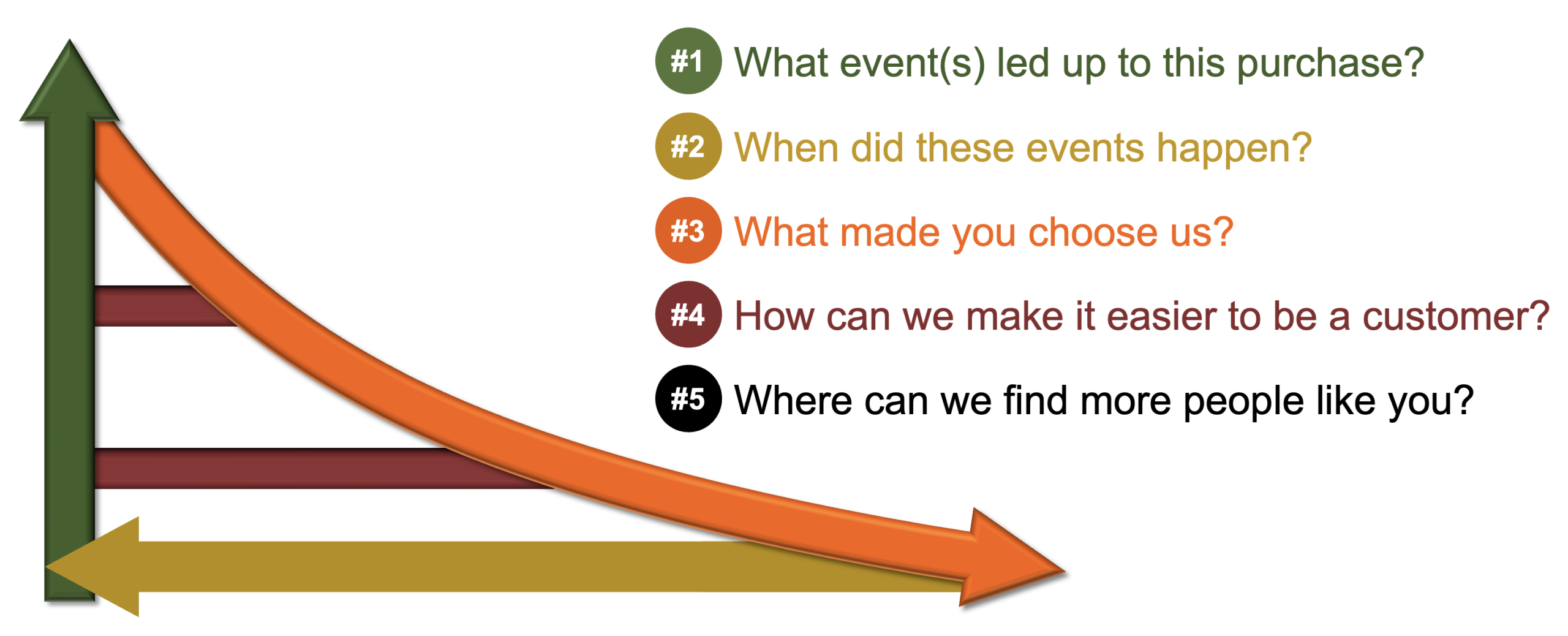
A structured 20-minute call with every new customer within 72 hours of closing, built around five specific questions, conducted while the decision is still fresh in their memory.
Memory decays fast, and reconstructed reasons are unreliable — a customer asked to explain their decision a month later will rationalize it differently than they would 72 hours in. The 5 questions surface the actual trigger, the actual language, and the actual decision path, not a tidied-up story.
After three of these calls patterns start to appear; after ten you can predict them.
1. Book the call within 72 hours of signature.
2. Ask: What events led up to this purchase? · When did they happen? · What made you choose us? · What can we make easier? · Where can we find more people like you?
3. Write down their exact words, not your summary of them.
4. After 5 calls, count which phrases repeat 3+ times. Those go into your Seven Second Sale.
5. If a customer struggles to recall the trigger, walk them backwards month by month until something surfaces.
Example: Three Won Sales Analysis calls surfaced the same phrase — "we lost track of who was actually coming in." The founder's website had said "workforce visibility platform." They changed the headline to the customer's exact words. Reply rates to cold outreach doubled in six weeks with no other change.
2. You know and have written down what your won deals have in common
What does "Analyze Wins, Not Losses" mean?
A written record of what your won deals have in common — the trigger, the language, and the decision path that shows up across them. Not a feeling you carry around; something you can point to.
Losses tell you what one prospect disliked — everyone loses for a different reason, so there is no pattern to find. Wins tell you the repeatable pattern: the trigger, the language, and the decision path that actually produce revenue.
In 2002 Craig Elias searched "lost sales analysis" and found 50,000 results; "won sales analysis" returned 2 — nearly every founder is looking in the wrong place.
1. After every closed deal, log whether you won or lost. If lost, note it and move on — do not spend analysis time there.
2. For every won deal, book the Won Sales Analysis call.
3. Resist the instinct to obsess over losses — it feels productive but produces no repeatable pattern, only a list of individual objections.
4. Review your calendar: are you spending more time dissecting losses than studying wins? If so, flip it.
5. After three won-deal analyses, look for the pattern across them — that pattern, not any single loss, is your playbook.
Example: A founder tracked her last 10 deals: 6 losses, 4 wins. She spent hours dissecting why each loss happened — price, timing, fit — and found six different, unrelated reasons.
She spent 20 minutes on each of the 4 wins and found the same trigger event behind three of them. The losses taught her nothing repeatable; the wins handed her a pattern in under two hours.
3. You have identified both trigger events behind each of your last 3 closed deals — the one that created dissatisfaction, and the one that gave them the time, money, or resources to act on it
What does "Trigger Event Backwards Map" mean?
The practice of tracing backwards from each closed deal to identify the three trigger events behind it: the <b>Want Trigger</b>, when the prospect first became dissatisfied with their status quo; the <b>Afford Trigger</b>, when something gave them the time, money, or resources to actually start searching for alternatives; and the <b>Justify Trigger</b>, when something finally let them justify saying yes and buying — creating a whole new status quo.
Most founders can find one, if any. The gap between the Want and Afford Triggers is your Window of Dissatisfaction™ — how much runway you have between "unhappy" and "actively looking." The Justify Trigger tells you what actually turns a prospect into a customer.
Knowing only the Want Trigger tells you who to watch. Knowing the Afford Trigger tells you how long you have before someone else gets there first. Knowing the Justify Trigger tells you what to give the next prospect at the closing stage so they can actually say yes.
Founders who only look for one trigger are working with a third of the picture. Three mapped deals start to show a shape; ten make it predictable enough to build a detection system around.
1. Open every Won Sales Analysis with two questions: "What first made you unhappy with how you were handling this?" (the Want Trigger) and "What changed that finally gave you the time, money, or resources to do something about it?" (the Afford Trigger).
2. If they cannot recall either, walk backwards month by month until something surfaces.
3. Log both events separately for each deal — do not collapse them into one.
4. After 3 deals, compare the gap between the Want and Afford Triggers across them — that gap is your Window of Dissatisfaction™.
5. There is a third question worth asking too: "What finally let you feel confident saying yes to us?" — the Justify Trigger. It will not show up in this box's score, but it tells you exactly what to say to the next prospect at the closing stage.
Example: All three of a founder's first enterprise deals followed the same pattern: a new VP of Operations created the dissatisfaction (Want Trigger), and a Q1 budget approval three weeks later gave them the resources to act (Afford Trigger). The three-week gap became her Window of Dissatisfaction — reach out by week two, or lose the deal to whoever else was watching.
On a hunch, she asked one more question in her next Won Sales Analysis: what finally made you comfortable saying yes? Every answer pointed to the same thing — a competitor's public price increase. That became her Justify Trigger: a reason to move now, not later.