compare
Where they overlap and where they differ
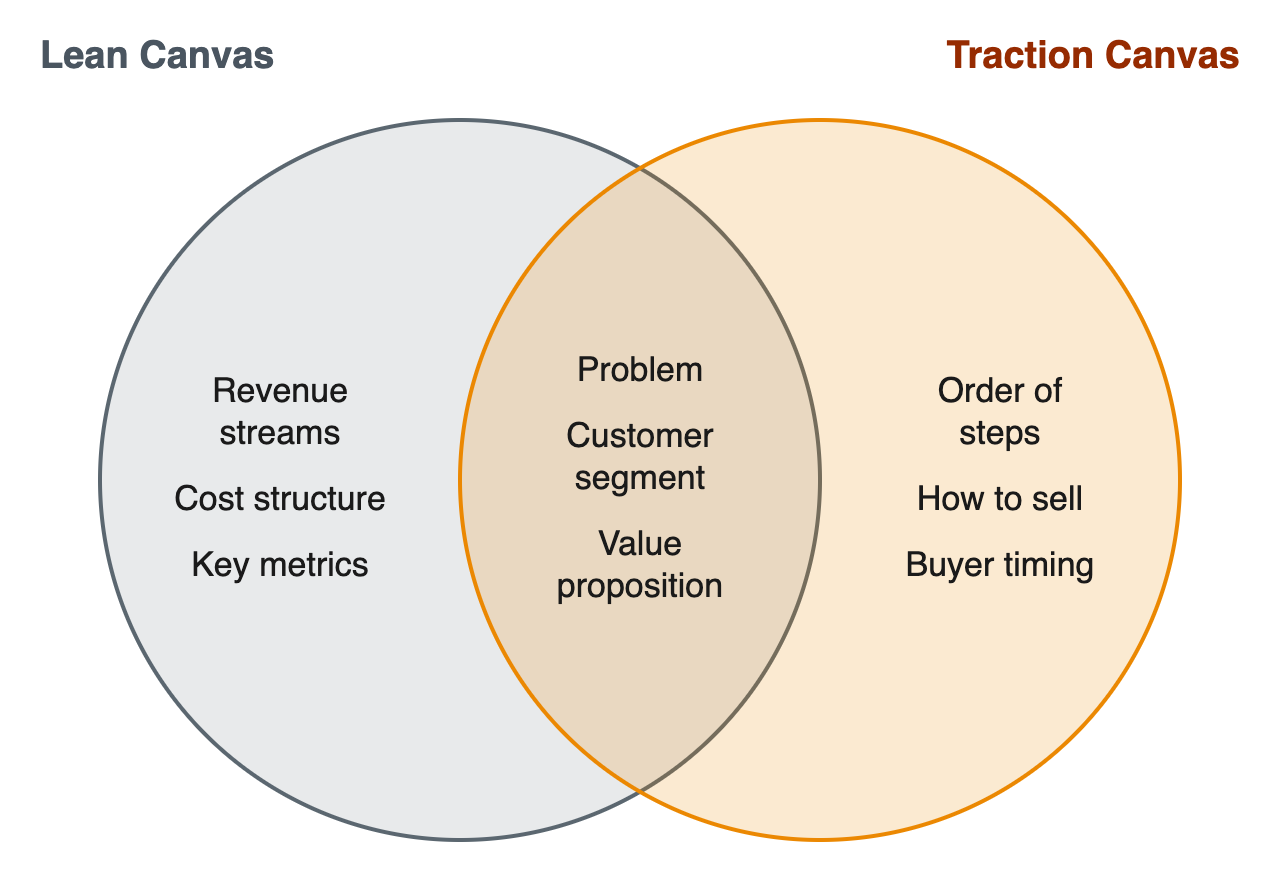 Left: covered by Lean Canvas only. Middle: covered by both. Right: covered by the Traction Canvas only.
Box by box
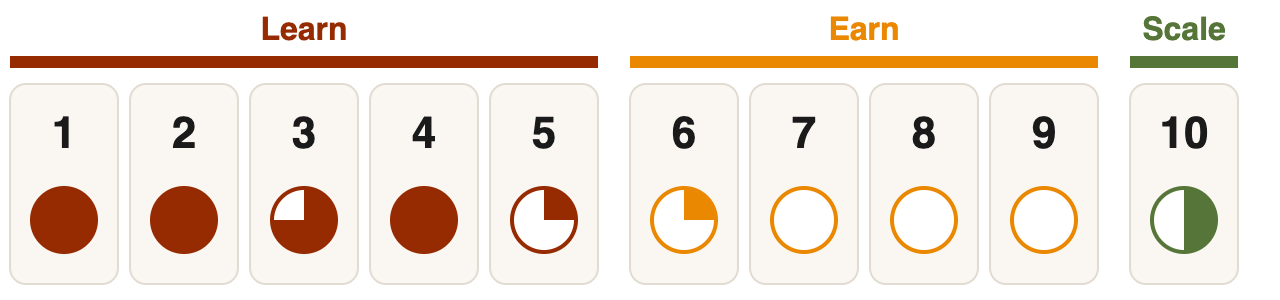 How much the Lean Canvas covers each Traction Canvas box. Full circle: a core focus. Empty: not covered. This is our own assessment; see all models compared.
The short answer: The Lean Canvas is a good planning tool: it describes your business model on one page. The Traction Canvas is an execution tool: a one-page sales playbook that shows you, step by step, how to go out and win your first customers. Plan with the Lean Canvas, execute with the Traction Canvas.
What Lean Canvas does well
Alexander Osterwalder created the Business Model Canvas, and Ash Maurya adapted it into the Lean Canvas for startups. The Lean Canvas captures the problem, customer segments, unique value proposition, solution, channels, revenue streams, cost structure, key metrics and unfair advantage on a single page. • It forces founders to write their business down in one place.• It highlights the riskiest assumptions to test.
• It is widely taught, so mentors and investors recognize it.
How Lean Canvas maps to the Traction Canvas
The Traction Canvas has ten boxes in three zones, completed in order: Learn (Boxes 1 to 5), Earn (Boxes 6 to 9) and Scale (Box 10). Here is how Lean Canvas lines up with it.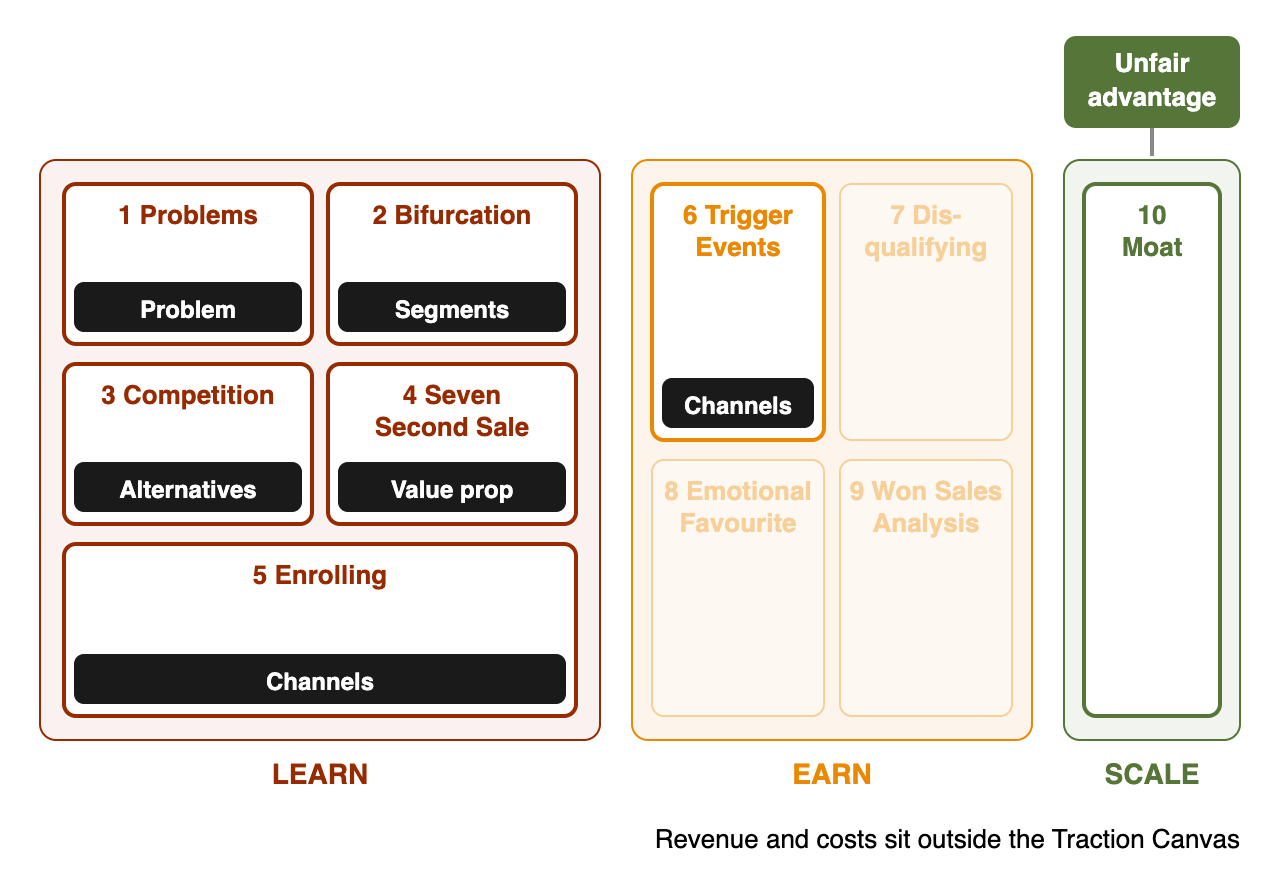 Where the Lean Canvas lands on the Traction Canvas. Faded boxes are not covered. The table below has the details.
Problem — Traction Canvas: Box 1: Problems / Learn zone. How it connects: Problems finds the one worth solving now.
Customer segments and early adopters — Traction Canvas: Box 2: Bifurcation / Learn zone. How it connects: Bifurcation narrows the market to the buyers most likely to act.
Existing alternatives — Traction Canvas: Box 3: Competition / Learn zone. How it connects: Competition covers every alternative a buyer has, including doing nothing.
Unique value proposition — Traction Canvas: Box 4: Seven Second Sale / Learn zone. How it connects: The Seven Second Sale creates almost instant interest.
Channels — Traction Canvas: Box 5: Enrolling / Box 6: Trigger Events / Learn, Earn zone. How it connects: Enrolling and Trigger Events are your first sales channels.
Unfair advantage — Traction Canvas: Box 10: Marketing Moat / Scale zone. How it connects: A Marketing Moat is a hard-to-copy advantage.
The gap Lean Canvas leaves
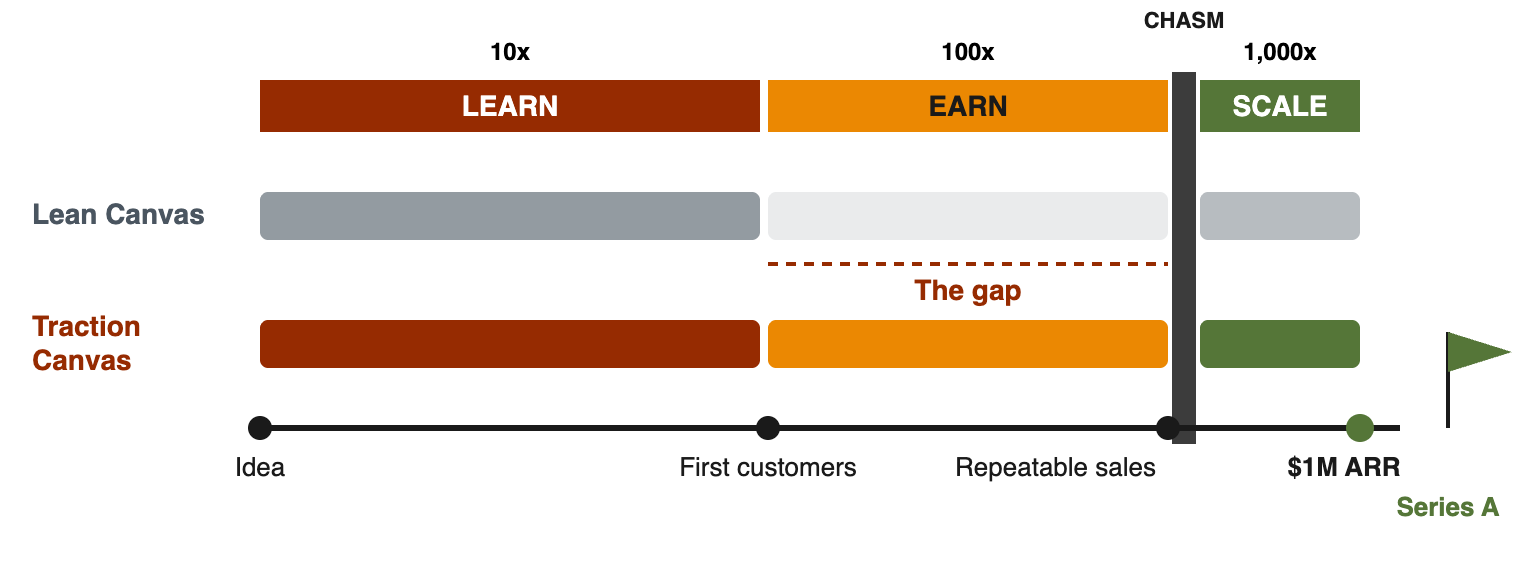 How far each canvas takes a founder on the road to $1M in ARR and a Series A. Bar strength shows how much of each zone is covered, using the box-by-box ratings above.
The Lean Canvas captures a business at one moment, but it doesn’t say what to do first, or how to sell. The Traction Canvas doesn’t cover revenue streams or cost structure, and the Lean Canvas doesn’t cover the sales work in Boxes 6 to 9.